


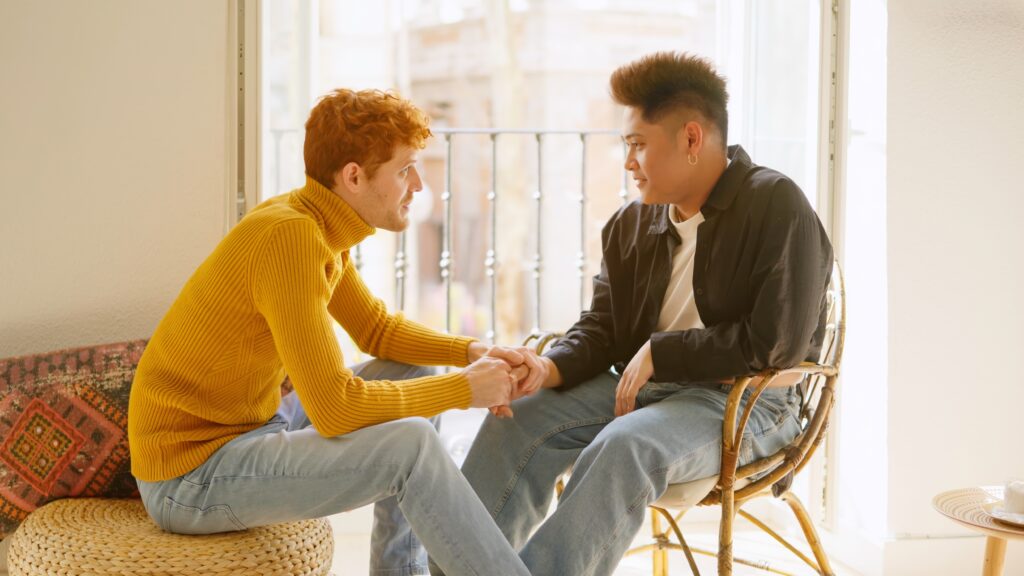
There is a particular ache to a fractured friendship within the queer community. Maybe it resembles other relational wounds on the surface. The same silence where conversation once flourished, the same careful navigation of shared spaces, the same late-night rehearsals of what you might say if given the chance. Yet something additional lives in these ruptures, something that reaches beyond the immediate pain of two people who can no longer occupy the same room with ease.
When friendships dissolve or damage themselves within LGBTQIA+ circles, they often take with them a sense of safety that many of us have spent years constructing. This isn’t melodrama. It is the simple recognition that for those of us who have experienced rejection from family systems, religious communities, or the broader culture, our friendships have frequently served as the architecture of our survival. They are not supplementary. They are foundational.
The Myth of Effortless Kinship
There exists a romanticized notion, perpetuated, perhaps, by our own deep hunger for belonging, that queer friendships should somehow transcend the ordinary difficulties that plague other relationships. We tell ourselves that shared marginalization creates an inherent understanding, that our mutual experience of otherness inoculates us against the garden-variety cruelties and misunderstandings that damage connection elsewhere.
This is wishful thinking, though not without its roots in something real.
What is true: there is often a shorthand between us, a shared literacy of experience that allows certain conversations to unfold with less preamble.
What is equally true: we are still individuals carrying our own histories of hurt, our own defensive architectures, our own unexamined biases and blind spots.
The queer community is not a monolith of perfect understanding. It is a collection of people who have often learned to protect themselves in ways that can inadvertently harm others.
Consider how many of us developed sharp edges simply to survive. The sarcasm that deflects vulnerability. The preemptive rejection before someone else can reject us first. The tendency to read threat into ambiguity because ambiguity has so often preceded harm. These are not moral failures. They are adaptations. Yet they do not always serve us well in the intimate work of maintaining friendship.
The Complications of Intensity in LGBTQIA+ Friendships
LGBTQIA+ friendships can become very intense, very quickly. When you find someone who understands the particular shape of your experience, who doesn’t require the exhausting translation work that heteronormative relationships often demand, it can feel like relief made flesh. This intensity is part of what makes these friendships so nourishing. It is also part of what makes their dissolution so devastating.
Intensity without structure tends toward volatility. When friendships become enmeshed, when boundaries blur and individual needs become difficult to distinguish from collective ones, minor conflicts can feel existential. A disagreement about plans becomes a referendum on loyalty. A failure to respond quickly enough to a text becomes evidence of abandonment. The stakes feel impossibly high because, in a sense, they are. These relationships hold so much of our sense of home.
This is where many ruptures begin: not in dramatic betrayals, but in the slow accumulation of small misattunements. One person needs more space than the other can tolerate. Someone’s mental health crisis demands resources that stretch the friendship beyond its capacity. Political disagreements reveal different values that can no longer be reconciled through affection alone. The friendship that once felt like salvation begins to feel like obligation, resentment quietly accruing like interest on an overdue debt.
On Being Harmed and Causing Harm in Chosen Family Dynamics
Possibly the most uncomfortable truth about healing queer friendships is this: we must hold simultaneously that we exist within systems designed to harm us, and that we are still capable of harming each other. These realities do not cancel one another out.
I have sat with countless individuals who struggle to reconcile these truths. They cannot fathom how a fellow queer person, someone who should understand what it means to be diminished, dismissed, or dehumanized, could treat them with such carelessness. The cognitive dissonance is profound. If oppression should teach us compassion, how do we make sense of its absence in people who have themselves suffered?
The answer, I’m afraid, is that trauma does not always make us kinder.
Sometimes it makes us vigilant to the point of paranoia. It can make us so defended that we wound others in our attempts to protect ourselves. Sometimes we redirect the anger that rightfully belongs to larger systems onto the people nearest to us, simply because they are within reach and the systems are not.
This does not excuse harmful behavior. It contextualizes it. And in that contextualization, we may find a foothold for the difficult work of repair.
The Specific Wounds: Common LGBTQIA+ Friendship Conflicts
Certain injuries appear with notable frequency in LGBTQIA+ friendship ruptures, and they warrant direct attention.
Jealousy masquerading as concern. Within small, interconnected communities, romantic entanglements often overlap with friendship networks in ways that create genuine complications. When a friend begins dating someone you were interested in, or when they achieve a milestone you’ve been struggling toward, the resulting jealousy can dress itself in more socially acceptable clothing. We tell ourselves we’re worried about their choices, or that we’re simply protecting them, when in truth we are managing our own difficult feelings poorly.
The weaponization of identity. Debates about who is “queer enough,” whose queerness is more legitimate or more radical, who has suffered more or understands the community better; these arguments cause tremendous damage. They often emerge from real frustration with assimilation politics or from protective instincts about community boundaries. Yet they frequently become cudgels used to establish hierarchy and exclude rather than thoughtful conversations about values and inclusion.
Boundary failures in both directions. Some friendships flounder because one person consistently violates the other’s boundaries; offering unsolicited advice, sharing confidential information, demanding access to time and emotional energy without reciprocity. Others collapse because boundaries become so rigid that genuine intimacy becomes impossible. Both patterns can emerge from the same root: uncertainty about where one person ends and another begins, a legacy of relationships where autonomy was not respected or modeled.
The burden of representation. When you are one of few queer people in someone’s life, you may be expected to educate, to explain, to serve as ambassador for an entire community’s worth of experiences. When this expectation exists between queer friends, when you are asked to represent your particular intersection of identities, to justify your choices, to perform your queerness in ways that make others comfortable, it breeds exhaustion and eventual resentment.
What Healing LGBTQIA+ Friendships Requires…And What It Doesn’t
Let me be clear about something that often gets obscured in therapeutic conversations: not all friendships should be healed. Some ruptures are the relationship telling you something important about its viability. Certain friendships have run their natural course. Some people have harmed you in ways that do not obligate you to offer them continued access to your inner life.
Healing does not always mean reconciliation. Sometimes it means accepting what happened, integrating the loss, and moving forward without that person in your daily landscape. This is not failure. This is discernment.
That said, for friendships where repair seems both possible and desirable, certain elements tend to prove essential.
Accountability without self-flagellation. If you have caused harm, you must acknowledge it clearly and without qualification. The apology that begins “I’m sorry you felt hurt, but you have to understand…” is not an apology. It is a justification wearing an apology’s clothing. Real accountability names what you did, acknowledges its impact, and commits to different behavior without expecting immediate forgiveness or absolution. Conversely, accountability does not require you to accept blame for things you did not do or to shrink yourself to make someone else comfortable. There is a difference between taking responsibility and taking on someone else’s inability to manage their own emotional experience.
The ability to tolerate discomfort. Repair is awkward. Stilted conversations will happen. Moments will come when you’re not sure if you’re doing this right. There will be the temptation to rush back to easy affection before the harder work of rebuilding trust has been completed. Both parties must be willing to sit with this discomfort rather than demanding premature resolution.
Curiosity about impact over intent. Your intentions may have been pure. You may have meant well. This does not erase the impact of your actions. Similarly, if you are the person who was harmed, you may need to consider that your friend’s intentions were not malicious even if their behavior was damaging. This is not about excusing harm. It is about creating enough nuance to understand what actually happened, which is necessary for figuring out if it can be prevented in the future.
Renegotiated expectations. The friendship you return to after a rupture will not be identical to the friendship that existed before. This is not necessarily a diminishment. Sometimes relationships grow stronger in the broken places, developing a resilience they previously lacked. But this requires both people to release their grip on what was and remain open to what might emerge.
The Particular Challenge of Community Entanglement
Individual friendships do not exist in isolation within LGBTQIA+ communities, especially in smaller cities or towns where the same faces appear at every event, every gathering, every safe space. When a friendship ruptures, you often face the additional complication of navigating shared community.
This can go several ways, none of them entirely comfortable.
Sometimes the community fractures along with the friendship, people unconsciously or consciously taking sides, choosing allegiances, determining whose version of events they believe. This is tribalism at its most basic, and while understandable, it tends to compound the original injury. What began as a conflict between two people metastasizes into factional warfare.
Other times, everyone attempts to remain neutral, which sounds diplomatic but often feels like abandonment to both parties. When no one is willing to acknowledge that harm occurred or to hold anyone accountable, the injured party may feel gaslit while the person who caused harm faces no consequences or opportunities for growth.
The most mature response, and the rarest, involves the community holding space for complexity. This means acknowledging that both people may have valid experiences and legitimate grievances. It means not requiring everyone to choose a side while also not pretending that harm didn’t occur. It means allowing relationships to exist at different levels of intensity and intimacy, recognizing that not everyone needs to be close friends with everyone else for the community to function.
This level of nuance requires a degree of emotional sophistication that many groups have not developed. People must tolerate uncertainty and to resist the urge toward black-and-white thinking. It is difficult work. It is also necessary work if we want to build communities capable of withstanding the inevitable conflicts that arise when human beings attempt to be in relationship with one another.
When the Friendship Was Also Romantic: Navigating Blurred Lines
The line between friendship and romance can be beautifully porous within queer communities. Many romantic relationships begin as friendships. Many romantic relationships return to friendship after their romantic component ends. And many relationships exist in that liminal space where labels feel inadequate to capture the full complexity of connection.
This fluidity is one of the gifts of queer relating, but it complicates rupture and repair.
When a friendship that was also romantic (or might have been romantic, or was romantic for one person but not the other) falls apart, you are grieving multiple losses simultaneously. You are losing the person who understood your particular brand of humor. You are also losing the person whose hand you held, whose body you knew, who occupied the space in your life reserved for romantic attachment.
Healing these relationships requires extraordinary honesty about what you’re actually grieving and what you’re actually hoping to rebuild. Can you genuinely return to friendship, or are you secretly hoping that proximity will reignite romantic feelings? Are you maintaining the friendship because you genuinely value it, or because you cannot tolerate the finality of completely losing this person from your life?
These are not comfortable questions. They deserve uncomfortable honesty.
The Long Work: A Realistic Timeline for Healing
I have been a therapist long enough to know that people arrive seeking strategies, techniques, clear steps they can follow to achieve the outcome they desire. This is reasonable. We live in a culture that promises solutions, that suggests every problem has a corresponding fix if only you can locate the right expert or the right approach.
Healing friendships, particularly friendships that carry the additional weight of being chosen family, of representing safety in a world that has often felt unsafe, is not a problem to be solved. It is a process to be moved through, and the timeline is not yours to dictate.
Some friendships heal quickly, the rupture revealing itself to be a misunderstanding that conversation can clarify. Others require months or years of careful rebuilding, trust returning in increments so small you barely notice until you look back and realize how far you’ve come. Still others never fully heal, but reach a place of acceptance where the ache no longer dominates your emotional landscape.
What I can offer is not a roadmap but a set of principles that tend to serve people well in this work.
Be honest about what you want. Do you want the friendship back, or do you want vindication? Do you want repair, or do you want the other person to suffer as you have suffered? These desires are not equally productive, but they are equally human. Name them, at least to yourself.
Make room for grief. Even if the friendship ultimately heals, you are grieving the version of it that existed before. Even if you are the one who ended things, you are allowed to be sad about what you’ve lost. Grief does not mean you made the wrong choice. It means you are capable of valuing what you’ve had to release.
Resist the urge to narrate yourself as purely victim or purely villain. Most relational ruptures involve some degree of mutual contribution, even if the contributions are not equal. This does not mean engaging in false equivalence or accepting blame for things that are not your responsibility. It means remaining curious about your own participation in the dynamic rather than constructing a story where you are entirely without agency.
Accept that the other person may not be capable of what you need from them. They may lack the self-awareness to understand their own behavior. Some may lack the emotional capacity to sit with discomfort. They may simply not value the friendship enough to do the difficult work of repair. This is information, not a referendum on your worth.
Tend to the other relationships in your life. When one friendship ruptures, there is often a temptation to pour all your relational energy into that loss, to the neglect of connections that remain intact. This compounds the damage. Your other friends need you. You need them. Do not let one ending consume everything else.
Moving Forward: Building Resilient LGBTQIA+ Friendships
Eventually, whether through reconciliation or acceptance, you will find yourself on the other side of the acute phase of grief. The friendship may have been restored to some new version of itself, or it may exist now only in memory. Either way, you must decide what you will carry forward from this experience.
The easy path is cynicism. You can decide that closeness is dangerous, that chosen family is a myth, that protecting yourself means maintaining emotional distance from everyone who might hurt you. This will keep you safe. It will also keep you lonely.
The harder path, and I believe the worthier one, is to allow this experience to refine rather than define your approach to friendship. Perhaps you’ve learned that you need to articulate boundaries more clearly. Maybe you’ve discovered that you move toward enmeshment when you’re anxious and need to develop other coping strategies. Perhaps you’ve realized that certain behaviors you tolerated in this friendship are actually non-negotiable dealbreakers for you going forward.
These lessons are not nothing. They are the material from which you build better, more sustainable relationships in the future.
The queer community needs friendship to survive. We need chosen family. We need the particular intimacy that comes from being known by people who understand what it means to exist in a world not designed for our flourishing. But we do not do these relationships any favors by pretending they should be effortless or by treating their rupture as unthinkable betrayal.
Friendship is work. Worthwhile work, nourishing work, but work nonetheless. It requires communication and repair and the humility to admit when we have been small or unkind. We have to show up even when showing up is uncomfortable. It requires us to believe that the people we love are capable of growth, and to extend that same generous belief to ourselves.
This is what healing looks like: not the erasure of hurt, but the integration of it.
Not the return to innocence, but the development of wisdom. Not the guarantee that you will never be hurt again, but the cultivation of resilience that allows you to survive hurt without hardening entirely.
You deserve friendships that feel like home. You also deserve friendships that can withstand conflict without collapsing, that have enough structural integrity to bend without breaking. These are not incompatible desires. They are the same desire, maturely expressed.
The work of building and healing and tending these relationships is some of the most important work any of us will do. It is worth doing well. It is worth doing even when it is difficult. Especially then.
FAQ
Q: How long does it take to heal a broken friendship in the LGBTQIA+ community?
A: There is no standard timeline. Some friendships repair quickly through conversation; others require months or years of gradual trust-building. Some never fully heal but reach a place of acceptance. The timeline depends on the severity of the rupture, both parties’ willingness to engage, and the depth of the original connection.
Q: Should I try to repair a friendship that ended badly?
A: Not necessarily. Consider: Was the harm severe and unacknowledged? Are patterns entrenched? Has the friendship run its natural course? Sometimes the healthiest choice is accepting the ending rather than forcing repair. Discernment, not determination, should guide this decision.
Q: How do I navigate shared LGBTQIA+ community spaces after a friendship breakup?
A: Establish clear, respectful boundaries. Communicate directly rather than through mutual friends. Allow the community to maintain relationships with both of you without forcing them to choose sides. Practice mature coexistence. You don’t need to be close, but you can be civil.
Q: What if my former friend won’t acknowledge the harm they caused?
A: You cannot control another person’s capacity for accountability. Focus on your own healing: processing the hurt, setting firm boundaries, and deciding whether you can accept the relationship as-is or need to release it entirely. Their lack of acknowledgment is information about their current limitations, not a reflection of your worth.
Q: How can I prevent future LGBTQIA+ friendship conflicts?
A: Establish clear boundaries early. Communicate needs explicitly rather than assuming shared understanding. Avoid enmeshment by maintaining separate identities and interests. Address small conflicts before they accumulate. Remember that shared identity doesn’t guarantee automatic compatibility or understanding.
About the Author

Mayme Connors, LPC-A, LCDC, NCC is a Dallas based therapist who works with LGBTQIA+ adults, couples, and polycules who are exhausted from performing stability, success, palatable queerness. Her clients come in burnt out, trying to figure out who they actually are beneath all the expectations and survival strategies.
Using approaches like Internal Family Systems (IFS), Gottman, Relational Life Therapy, and DBT, Mayme helps clients untangle the deeply held beliefs from family, culture, or society that keep them stuck. She’s collaborative, sometimes irreverent, always honest, and deeply present.
Therapy with Mayme isn’t sterile. It’s messy and magical and hard, one badass step at a time.
